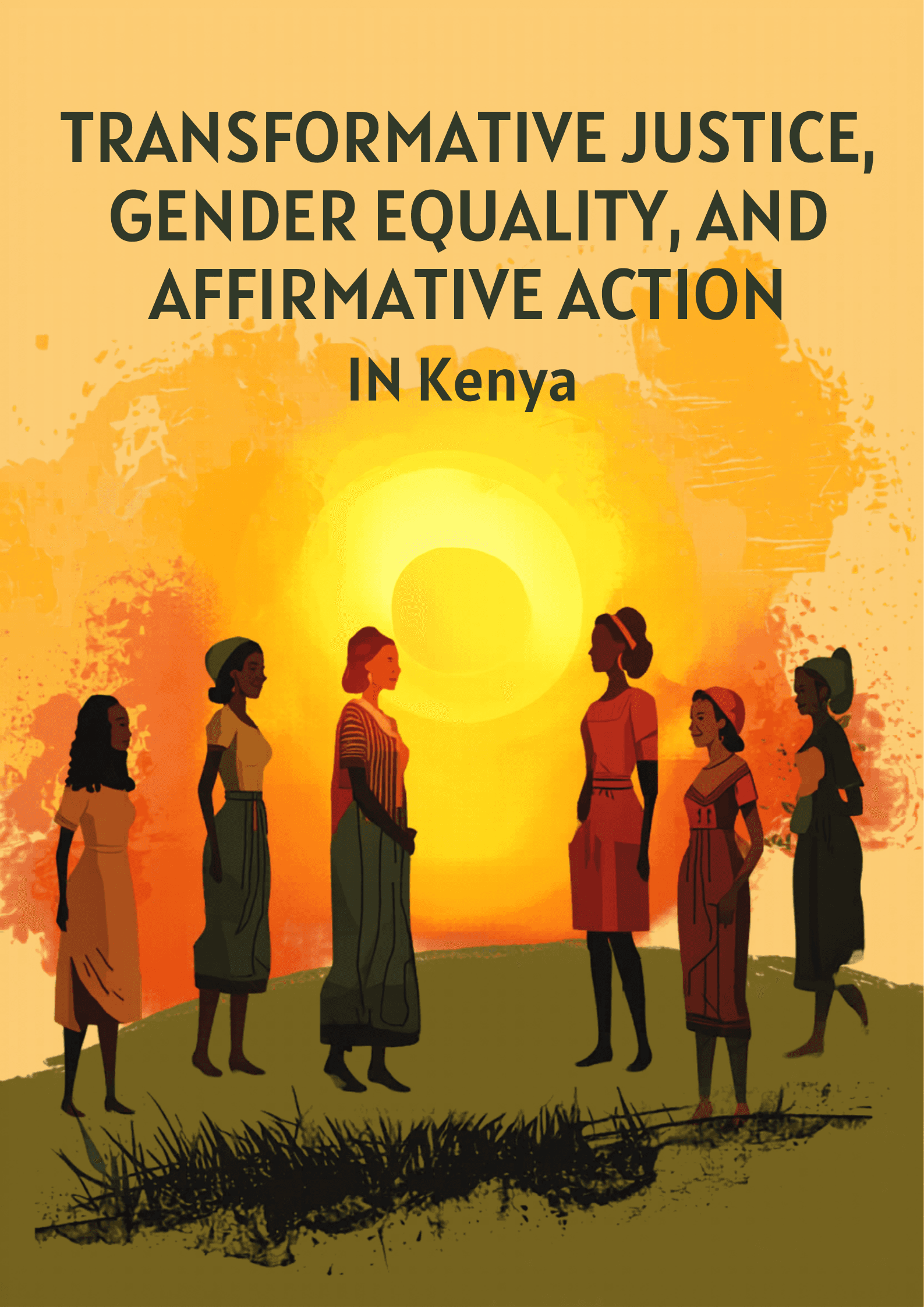
TRANSFORMATIVE JUSTICE, GENDER EQUALITY, AND AFFIRMATIVE ACTION IN KENYA
TRANSFORMATIVE JUSTICE, GENDER EQUALITY, AND AFFIRMATIVE ACTION IN KENYA TRANSFORMATIVE JUSTICE Transformative Justice is a political Approach and approach to addressing violence, harm, and abuse. At its most basic, it aims to respond to violence without triggering further violence and or engage in damage reduction to reduce the violence. Transformative Justice can be viewed as a means of making things right, achieving right relation, or working together to create justice. Transformative justice responses and interventions (Transformative Justice: A Brief Description, 2024). 1) Do not rely on the state (e.g., police, prisons, the criminal legal system, I.C.E., foster care system (though some Transformative Justice responses do rely on or incorporate social services like counseling) 2) Do not reinforce or perpetuate violence, such as oppressive norms or vigilantism. 3) Actively cultivate the things we know prevent violence, such as healing, accountability, resilience, and safety for all involved. (Transformative Justice: A Brief Description, 2024). AFFIRMATIVE ACTION On the other hand, Affirmative action is a policy that seeks to increase employment and educational opportunities for people who are underrepresented in numerous aspects of our society. It focuses on demographics that have previously been underrepresented in leadership and professional positions. It is frequently considered a technique of combating discrimination against specific populations (Kenton, 2025). Businesses and governments routinely use affirmative action programs to hire people based on their race, gender, religion, or national origin. It is frequently utilized in educational contexts in the United States, particularly for college admissions. However, in the 2023 case of Students for Fair Admissions v. Harvard, the Supreme Court stated that schools and universities may no longer use race as a specific factor for admission (Kenton, 2025). In Kenya, these principles are included into the Constitution and reinforced by international agreements such as the Maputo Protocol and the Universal Periodic Review (UPR). INSTITUTIONS/GOVERNING BODIES CREATED TO ENFORCE AFFIRMATIVE ACTION POLICIES NATIONAL GENDER AND EQUALITY COMMISSION (NGEC) As an oversight body, over 60% of the Commission's basic job is to monitor, audit, and investigate the implementation of the Constitutional provisions on all elements of gender equality and freedom from discrimination. The National Gender and Equality Commission increase the capacity of public and corporate organizations to integrate gender equality and anti-discrimination principles into all administrative procedures, policies, laws, and programs. In addition, the Commission also improve its systems and processes for accepting complaints and responding to any reported infractions. The Commission will work with appropriate partners to ensure that victims of violations of equality and inclusion receive speedy remedy. The NGEC also reports to Parliament on the status of gender equality and discrimination, as well as assuring conformity with treaties and conventions ratified by Kenya on problems of equality and freedom from discrimination for all special interest groups (Thematic Area: Compliance and Monitoring, n.d.). KENYA NATIONAL COMMISSION ON HUMAN RIGHTS (KNCHR) The Kenya National Commission on Human Rights (KNCHR) is an independent National Human Rights Institution formed by Parliament under the KNCHR Act of 2011 in accordance with Article 59 of Kenya’s Constitution of 2010. It is the state's primary agency for the promotion and protection of human rights. The KNCHR’s actions are directed by the United Nations-approved Paris Principles for the formation and operation of independent national human rights agencies. The International Co-ordinating Committee of National Human Rights Institutions (ICC), based in Geneva at the Office of the High Commissioner for Human Rights, has accredited the National Commission as a ‘A status’ institution, indicating that the Commission is in compliance with the principles. The KNCHR is a member of the Network of African National Human Rights Institutions (NANHRI), the ICC’s regional organization for Africa (Kenya National Commission on Human Rights > About Us > Establishment, n.d.). The primary goal of the KNCHR is to investigate and provide redress for human rights violations, to research and monitor compliance with human rights norms and standards, to conduct human rights education, to facilitate training, campaigns, and advocacy on human rights, and to collaborate with other stakeholders in Kenya (Kenya National Commission on Human Rights > About Us > Establishment, n.d.). JUDICIARY AND PARLIAMENT The application of the two-thirds gender rule in Kenya is a constitutional duty, not a matter of political goodwill. The Kenyan government, as the primary duty bearer under Articles 21(1&2) of the 2010 Constitution, is required to enact and enforce legislation to ensure the implementation of the 2/3 gender rule, as stated in Article 27(8), which states: “the state shall take legislative and other measures to implement the principle that no more than 2/3 of the members of elective and appointive bodies shall be of the same gender.” As a result, this is not a purely discretionary act that the government can implement whenever it wants. It is also not a progressive clause, as are several of the other rights guaranteed under Chapter IV of the Bill of Rights. It was intended to be implemented immediately following the proclamation of the 2010 constitution to ensure the protection of fundamental rights. The Parliament, in particular, is responsible for ensuring this by initiating and enacting the appropriate laws to assist implementation and guarantee equal representational rights for men and women in electoral and appointive bodies (Mbs, 2025). GENDER EQUALITY VS GENDER PARITY VS GENDER EQUITY AND HOW THEY ARE DEVELOPING IN KENYA GENDER EQUALITY Kenya adopted a new constitution on August 27, 2010. This was known as the ‘second republic’ Kenyans 20-year struggle for a new constitutional system has ended. Among other things, it recognized women’s human rights. The 2010 Constitution recognizes dignity, economic, social, and cultural rights, such as education, housing, and reproductive health care. Leaders prioritize equality and non-discrimination. National values and principles of governance encompass human dignity, equity, social justice, inclusivity, equality, human rights, non-discrimination, and protection for marginalized groups (LICHUMA & NATIONAL GENDER AND EQUALITY COMMISSION, 2017). The fourth chapter of the Kenyan Constitution is the Bill of Rights. Everyone is equal before the law and entitled to equal protection and benefits of the law. Women and men are entitled to equal treatment and opportunities in politics, economics, culture, and society. Both direct and indirect discrimination are prohibited. The state is responsible for implementing affirmative action programs and policies to address previous prejudice against individuals and groups. The provision specifies that the State must implement legislative and other steps to ensure that no more than two-thirds of elective body members are of the same gender, in addition to the measures outlined in clause 6. The decentralization of power resulted in 47 county governments. This has transformed lower-level leadership and increased the number of female public leaders (LICHUMA & NATIONAL GENDER AND EQUALITY COMMISSION, 2017). Despite the above gender equality in Kenya has not been met Kenya’s progress toward gender equality has taken a concerning turn, with the country’s gender parity score dropping by 3%, according to the most recent data. This decline marks a reversal in the country’s steady push toward equal representation and opportunities for women across political, economic, and social spheres. According to the World Economic Forum’s 2025 Global Gender Gap Report, Kenya fell behind on all four major metrics used to determine gender equality in the year running up to 2025. These include Economic Participation and Opportunity, Educational Achievement, Health and Survival, and Political Empowerment. To begin, Kenya had a gender gap score of 0.738 during the assessment period, ranking 43rd out of 148 nations surveyed internationally. This is down from the previous year's score of 0.789, which placed Kenya 13th out of 146 countries. Kenya, on the other hand, received a 0.971 on the Health and Survival index, ranking 64th, down from 0.975 and 52nd the previous year. Political Empowerment had the lowest parity score of the four measures, at 0.200, placing 86th internationally. This is a further decrease from the previous year’s score of 0.210 and rank of 80 (Onyango, 2025). Overall, Kenya’s Gender Gap Index was 0.689, down 3.4 percent from the previous year’s score of 0.713.A score of one implies parity, while a value much lower than one indicates a big discrepancy. Kenya’s score of 0.689 ranks it 98th out of 148 countries tested during the review period, a 23-place reduction from the previous year’s rank of 75, when the country scored 0.713.A higher score implies that a country is doing well in its quest of gender equality and has achieved great progress in closing the gender gap (Onyango, 2025). GENDER PARITY The concept of relative equality refers to the proportions of men, women, girls, and boys. Gender parity refers to the ratio of female to male values (or males to females in some circumstances) for a given indicator (Glossary of Terms and Concepts UNICEF Regional Office for South Asia November 2017, n.d.). In Kenya gender parity is met by the third gender rule Kenya’s constitutional commitment to gender equality and inclusive governance is based on the premise of not exceeding two-thirds gender representation. According to Articles 27(6) and 27(8) of the Constitution, no more than two-thirds of elected or appointed public officials must be of the same gender. The State must implement legislative, policy, and affirmative action measures to rectify historical marginalization and achieve equitable representation. Kenya’s Constitution requires full integration of men’s and women’s perspectives, experiences, and interests in law and policy formulation, fostering a diverse governance structure. Despite a strong legislative foundation, fully implementing the not more than two-thirds gender norm remains challenging. Gender mainstreaming progress has been distinguished by both significant milestones and persistent hurdles, such as low financial allocations, poor technical competence, and entrenched sociocultural attitudes that impede successful implementation (REPUBLIC OF KENYA MINISTRY OF GENDER, CULTURE AND CHILDREN SERVICES STATE DEPARTMENT FOR GENDER AFFAIRS AND AFFIRMATIVE ACTION REPORT ON THE STATUS OF IMPLEMENTATION OF THE NOT MORE THAN TWO-THIRDS GENDER PRINCIPLE IN MDACS FOR THE 2024/2025 FINANCIAL YEAR, n.d.). GENDER EQUITY The process of being fair to men and women, boys and girls, and, most importantly, ensuring equal outcomes and results. Gender equity may entail the implementation of temporary specific measures to compensate for past or systemic bias or discrimination. It refers to fair differential treatment that positively tackles a bias or disadvantage caused by gender roles, norms, or sex differences. Equity ensures that women, men, girls, and boys have an equal opportunity, not only at the start but also when they reach the finish line, it is concerned with the fair and just treatment of both sexes, taking into account the differing needs of men and women, cultural barriers, and (historical) prejudice against a certain group (Glossary of Terms and Concepts UNICEF Regional Office for South Asia November 2017, n.d.). Accelerating gender equity and inclusivity in the Kenya’s employment sector is critical for creating a fair, varied, and long-term workforce that maximizes the potential of all persons. The gender employment gap refers to the discrepancy in employment rates between men and women. The Kenyan Constitution (2010) stresses gender equity and inclusive employment. Furthermore, Article 27 ensures equality before the law by outlawing discrimination based on a variety of factors, including gender. It requires affirmative action to address previous discrimination. Article 41 guarantees equitable employment practices. Articles 27(6) and 81(b) mandate gender balance in elected and appointive bodies. Article 232 encourages open and gender-equal recruitment in the public service. Furthermore, the Kenyan Constitution's two-thirds gender rule requires that no more than two-thirds of elected or appointed public officials be of the same gender, as stipulated in Articles 27(8) and 81(b). The existence of gender employment gaps, salary discrepancies, occupational segregation, and unequal representation in leadership positions demonstrates the absence of a fully equitable and inclusive labor market (Promoting Gender Equity and Inclusivity in the Employment Sector in Kenya – KIPPRA, 2025). HOW STUDENTS CAN GET INVOLVED IN PROMOTING JUSTICE (YOU CAN INCLUDE INFORMATION LIKE INCLUSIVE OF VOTING, STUDYING AND HOLDING DISCUSSIONS AND CIVIC EDUCATION) Students have a key role in furthering transformational justice and equality through active, informed, and organized engagement. The major measures they take to promote a just, equitable, and democratic society are as follows: 1. Vote for leaders who advocate equality and justice, and ensure that political representation reflects the concerns of underrepresented communities (Google Search, n.d.). 2. Study: Taking specialist courses in law, gender studies, and civic education to create a solid foundation in human rights (Google Search, n.d.). 3. Discuss: Organizing justice and equality forums, discussions, and workshops to confront deeply ingrained systemic inequities (Google Search, n.d.). 4. Educate: Participating in civic education initiatives to increase understanding of rights and teach youngsters and community members about fairness (Google Search, n.d.). 5. Advocate: Participating in and organizing youth-led campaigns to promote the two-thirds gender rule, the protection of marginalized groups, and other social justice measures. 6. Leverage Digital Platforms: Using social media to raise awareness about digital violence, promote human rights information, and amplify minority perspectives (Google Search, n.d.). 7. Promote inclusivity by acting as bystanders and calling out sexism, racism, and harassment, as well as fostering polite, non-discriminatory language and behavior in schools and communities (Google Search, n.d.). 8. Volunteering at community centers, such as food banks or schools, can directly benefit underprivileged people (Google Search, n.d.) Students’ actions contribute to shift cultural norms away from passive compliance with injustice and toward active, transformational, and egalitarian engagement (Google Search, n.d.). In conclusion transformative justice, gender equality, and affirmative action in Kenya is something that is growing year by year and eventually by time the goal set for the above will be clearly met with every step being under taken by the Kenyan government and bodies that have been set.
This verified field story is published with consent and reviewed by Kitara's safeguarding and editorial teams before release.